
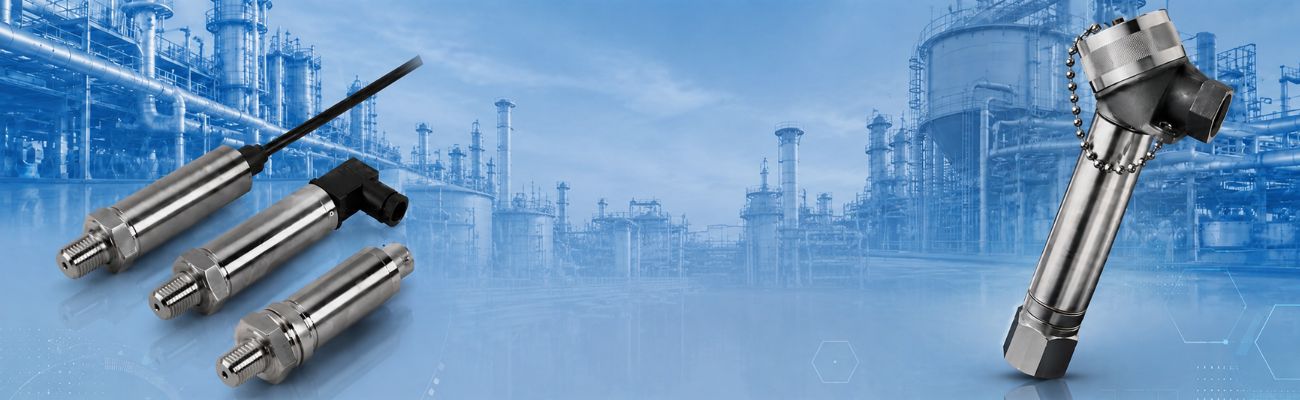
Pressure measurement sits at the core of process control, whether you’re monitoring a hydraulic circuit, protecting a compressor from cavitation, or verifying containment in a pharmaceutical clean room. Get the sensor selection wrong and you end up with drift, nuisance trips, or outright failure in the field. Omega Engineering (part of DwyerOmega) offers one of the broadest pressure sensor and transmitter in the industry, and understanding how the major product families differ is the fastest way to specify correctly the first time.
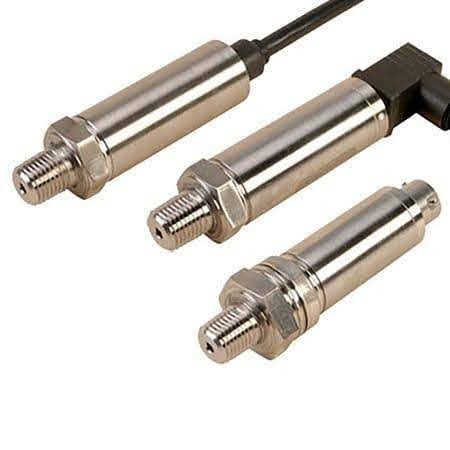
Omega’s PX409 series — a configurable, high-accuracy (±0.08%) pressure transducer.
Pressure Transducers vs. Transmitters: A Quick Refresher
The terms are often used interchangeably, but there’s a practical distinction worth keeping in mind:
- Pressure transducers typically output a raw, low-level signal (millivolt or low-voltage) proportional to pressure. They’re common in OEM and lab environments where signal conditioning happens downstream.
- Pressure transmitters include onboard signal conditioning and amplification, delivering an industry-standard output — most commonly 4–20 mA — that can run long cable distances without significant signal loss, making them the standard choice for industrial process control loops.
Omega’s catalog spans both categories, plus specialized variants (submersible, sanitary, intrinsically safe, explosion-proof) built for specific environments.
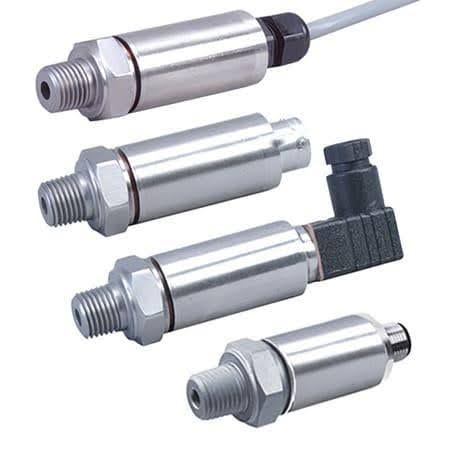
The PX309 — a general-purpose stainless steel transducer with ±0.25–0.5% accuracy, one of Omega’s most widely specified workhorse series.
Key Specifications to Match Before You Buy
When comparing pressure instruments, six parameters typically decide whether a sensor is fit for purpose:
- Pressure range and type. Gauge, absolute, vacuum, compound, sealed gauge, differential, and barometric measurement types cover different reference conditions. A gauge sensor measures relative to ambient atmosphere; an absolute sensor references a fixed vacuum; a differential sensor measures the difference between two process points (critical for filter monitoring or flow measurement via orifice plates).
- Output signal. The catalog offers current (4–20 mA, including HART-enabled variants), voltage (0–5V, 0–10V, ±10V), millivolt/ratiometric (mV/V), and digital outputs like USB or RS485. Current loop outputs remain the default for long-distance industrial installations because they’re inherently noise-resistant.
- Accuracy. Published accuracies across the line run from about ±1% down to ±0.05% of full scale, with several configurable series rated at ±0.08%. Tighter accuracy costs more, so it’s worth matching the spec to the actual control or safety requirement rather than defaulting to the highest number available.
- Wetted materials and media compatibility. 316L and 17-4 stainless steel are the most common wetted materials, suited to clean gases, water, oils, and many process fluids. Corrosive chemicals, hydrogen service, or sanitary food/pharma applications call for specific alloys or diaphragm coatings — this is where checking the media compatibility filter before ordering saves a costly return.
- Process and electrical connections. NPT, BSPP, tri-clamp (sanitary), flush-diaphragm, and submersible cable configurations address different mounting realities. Electrical termination options range from simple cable exit to M12 connectors, DIN 43650 solenoid-style connectors, and mil-spec connectors for vibration-prone or hazardous installations.
- Approvals and environment. For hazardous locations, look for FM, CSA, or ATEX intrinsic-safety and explosion-proof ratings. NEMA 4X and IP-rated enclosures matter for washdown or outdoor installations.
Notable Product Families
A few series illustrate how Omega segments the line by application:
Intrinsically Safe & Explosion-Proof: PX880, PX835, Series 3200G
PX880 — FM and CSA approved for hazardous locations, corrosive media, 15 to 3,000 psi.
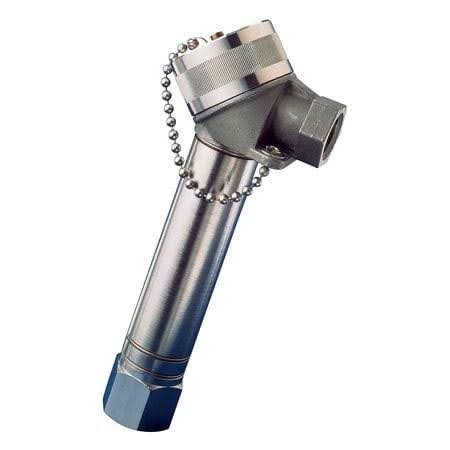
FM, CSA, ATEX, or UL-approved units (also including the PX509-IS, ±0.08% accuracy) are built for oil & gas, chemical processing, and other hazardous-classified areas.
Sanitary Transmitters: PX3005K
3-A and clean-in-place compatible designs for food, beverage, dairy, and pharmaceutical service, with the PX3005K adding a backlit LCD display for local readout.
Submersible Transmitters: PX633
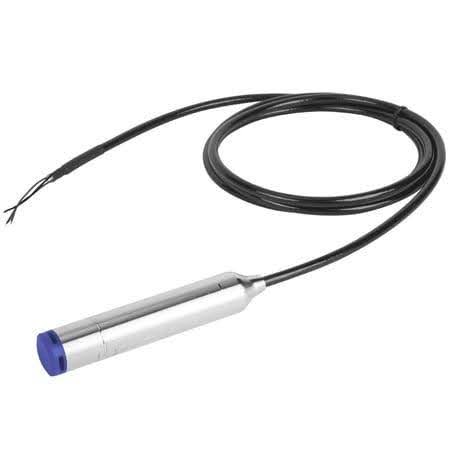
X633 — sealed, temperature-compensated, watertight construction for hydrostatic level and underwater pressure measurement.
General-Purpose Workhorses: PX309 / PXM309
Covered above — the standard choice for everyday industrial pressure monitoring, offering ±0.25–0.5% accuracy with low drift across a wide range of connection and output options.
Configurable High-Accuracy: PX409 Series
Covered at the top of this article — built for labs and test stands where ±0.08% accuracy and flexible output/connection configuration matter more than unit cost.
A Practical Selection Workflow
- Define the measurement type — gauge, absolute, or differential — based on what the pressure is referenced against.
- Set the full-scale range with margin above expected maximum operating pressure (many series specify burst and proof pressure as multiples of full scale, e.g., 3x or 4x, which tells you how much abuse the diaphragm tolerates before failure).
- Confirm media compatibility against the wetted material list, not just the nominal fluid — trace contaminants or cleaning chemicals can matter as much as the primary process fluid.
- Pick the output signal that matches your control system or data acquisition input.
- Check environmental and hazardous-area requirements — enclosure rating, temperature range, and any required agency approval.
- Match process and electrical connections to what’s already installed, or budget for adapters.
Where to Go Deeper
Omega’s pressure sensor and transmitter is filterable by all of the parameters above — pressure range, output signal, media compatibility, accuracy, wetted materials, connection type, and approvals — which makes it possible to narrow 50+ product.
Getting pressure measurement right is less about finding the single “best” sensor and more about matching six or seven interlocking specs to your actual process conditions. Spend the extra ten minutes on that matching exercise up front, and you’ll avoid the far more expensive exercise of troubleshooting a misspecified instrument in the field.