
Is moisture silently damaging your system without you even noticing?
In industry, water vapour is a hidden enemy that causes corrosion, frozen pipes, ruined products, and costly downtime.
That’s why understanding and controlling humidity is so important. Dew point measurement gives you a clear, practical way to track and manage moisture in air and gas streams.
What is dew point?
The dew point is the temperature at which air becomes fully saturated with moisture.
When air cools down to this temperature, it can no longer hold all the water vapour, so the excess turns into liquid – this is called condensation.
In short: Dew point = the temperature where condensation starts.
Dew point vs. Relative humidity
People often confuse dew point and relative humidity (RH), but they are not the same:
Dew point is a temperature (for example, 5 °C). It tells you the real amount of moisture in the air.
Relative humidity is a percentage (for example, 60%). It tells you how close the air is to saturation at its current temperature.
Think of it this way:
Dew point = how much water is actually in the air.
Relative humidity = how “full” the air feels at that temperature.
Controlling dew point is not just theory – it directly affects your operations
Why Dew Point matters in Industrial processes:
Quality control
Prevents spoilage and contamination of products (for example, in food, pharma, electronics).
Reduces defects caused by moisture on surfaces or in materials.
Equipment protection
Helps avoid corrosion and rust in pipes, valves, and machinery.
Prevents icing and condensation in compressed-air systems and cold sections.
Energy efficiency
Allows you to control drying and dehumidification more accurately.
Avoids over-drying or over-cooling, which wastes energy.
Meeting Regulations
Many international industrial groups set global standards for quality, and these often include limits for moisture or dew point.
An example is the EASEE gas standards for natural gas, which define the maximum allowed water and hydrocarbon dew-point levels to ensure safe and reliable gas quality.
Factors influencing the Dew point
The Dew point is mainly affected by a few basic things. If any of these change, the dew point can rise or fall.
1. Temperature
Temperature does not change the dew point itself, but it decides when condensation happens.
When air is cooled, its relative humidity increases. If the temperature drops to the dew point temperature, condensation starts on cold surface.
2. Amount of Moisture (water vapor)
- The more water vapor in the air or gas, higher the dew point.
- The less moisture, lower is the dew point
- Removing moisture (using dryers,
desiccants, or filters) lowers the dew point; adding moisture or air leaks from humid areas raises it.
3. Pressure
Pressure is an important variable that determines the dew point. It can affect dew point by influencing the air capacity to hold water vapor.
When pressure increases, the gas molecules are compressed, and the gas becomes denser.
In dense air, water molecules are more likely to collide with each other and condense into liquid water.
This means, under low pressure conditions, gas or air can hold more water vapor before reaching saturation at 100%.
A common principle when measuring dew point is that an increase in pressure generally raises the dew point, while a decrease in pressure lowers it.
- When air or gas is compressed, dew point goes up even if the real moisture stays the same. This is called Pressure Dew Point (PDP).
- When pressure drops, dew point goes down.
- Dew point at High pressure is higher than the dew point at atmospheric pressure. So, you must convert PDP to atmospheric dew point when comparing measurements or readings.
Mixing up PDP and atmospheric dew point can lead to wrong conclusions about moisture level.
Unlike other process variables, temp. and pressure, moisture has two unique
characteristics:
- It is difficult to measure accurately since moisture is directly affected by pressure and temperature.
- Process moisture is often a contaminant and it can severely damage processes, equipment and reduce product quality.
Selecting right dew point measurement tool/technology will be a great asset.
What is the best way to measure dew point in an industrial process?
There are many options available to measure dew point in industrial processes – the final choice depends on specific application and often budget.
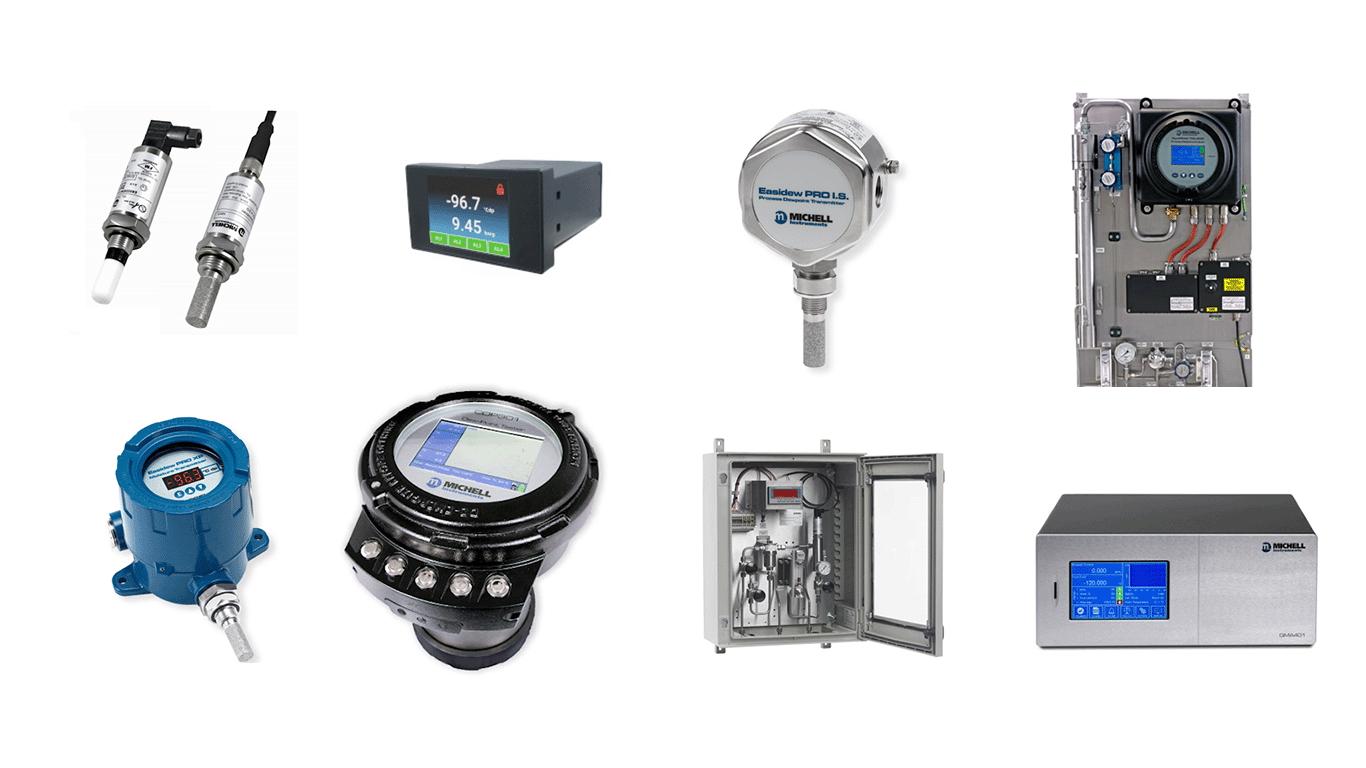
- Dew-point Transmitters
Dew point transmitters are small and cost effective and suited to a wide range of safe and hazardous applications. - Portable Dew-point Hygrometers (Dew point meters)
Portable Dew-point Hygrometers are most suited for test and verification purposes. You can use them to move around the system and find where moisture is entering such as at leak points in pipes or ducts. - Process Moisture Analyzers
Process Moisture Analyzers are usually systems that are built for harsh or hazardous areas, but not always. The typically include a sample handling unit and a moisture analyzers in one package.
These analyzers are mostly designed for use in places like oil refineries or natural gas processing plants where safe and continuous moisture monitoring is required. - Chilled Mirror Hygrometers
Chilled Mirror Hygrometers work by cooling a small mirror until moisture just starts to condense on it, and then measuring that temperature as the dew point. They are very accurate and stable, with little drift over time – although they are often used as reference instruments in labs, many models are also suitable for continuous monitoring in industrial applications like semiconductor manufacturing or metal processing.
Key considerations for Selection:
- Accuracy and Range – Make sure sensor can measure the dew-point values you need and with the accuracy your process demands.
- Response time – Sensor should react quickly so can see changes in dew point as soon as they happen.
- Durability and Resistance – Choose a sensor that can handle harsh conditions like high temperature, pressure, dust, or corrosive gases without failing.
Real-World Applications across Industries
- Compressed Air Systems – Dew point is monitored all the time in compressed air lines.
In general, it keeps the air dry so that pipes, valves and pneumatic tools do not corrode or freeze. - Medical and Breathing Air – Very strict dew point limits are followed to ensure that breathing gases are safe and free from moisture damage.
- Food and Beverage – Dew point control prevents moisture from getting into packaging and protects products during processing.
- Pharmaceuticals – In the pharmaceuticals industry, product quality and sterility rely on very tight control of dew point in cleanrooms and manufacturing areas. Keeping the dew point low helps prevent moisture related contamination, microbial growth, and changes in product
stability. - Semiconductor and Electronics – Without proper dew-point control, condensation and moisture can cause electrical shorts and reduce product reliability.
- Natural Gas – Dew point is controlled to stop hydrates from forming and blocking pipelines.
- Hydrogen Refueling Stations – In hydrogen refueling stations, controlling the dew point of hydrogen gas is critical. Dry hydrogen gas is used to prevent icing
and condensation in the refueling nozzle, pipes, and vehicle tanks, especially in cold weather. - Marine and Military – In ships and military systems, large water tanks called ballast tanks are filled or emptied to control the vessel’s balance. This is done using pneumatic air systems or valves that are operated by compressed instrument air.
If Air is too wet (High Dew Point) – When the air expands and cools in pipes, valves, water can condense and even freeze.
This ice formation and water can block valves, stop signals or damage sensitive controls.
We can say Dry Air, controlled by Dew point measurement, ensure safe and reliable operation of ballast tank valves and pneumatic systems in Marine and Military systems. - Battery Manufacturing – Correct Dew point protects electrodes from moisture and avoid corrosion during production.
- Carbon Capture, Utilization, and Storage (CCUS) – Precise dew point control improves safety, equipment life, and the efficiency of CO2 and other gas streams.